
A shared execution baseline turns opinions about risk into a range a leadership team can act on.
For most leadership teams, the hardest part of execution is not disagreement. It is agreement nobody can prove.
Everyone senses where execution is straining. Views differ on how much it matters, where it matters most and what to fix first. Each function brings the indicator it trusts most: an engagement score, a project dashboard, a variance report. Each is right about its own corner, and the meeting ends with a request for more context.
One move helps: a credible execution baseline. Its purpose is not to judge performance. It gives the room one shared reference point to decide from.
Why belief-based debates are costly
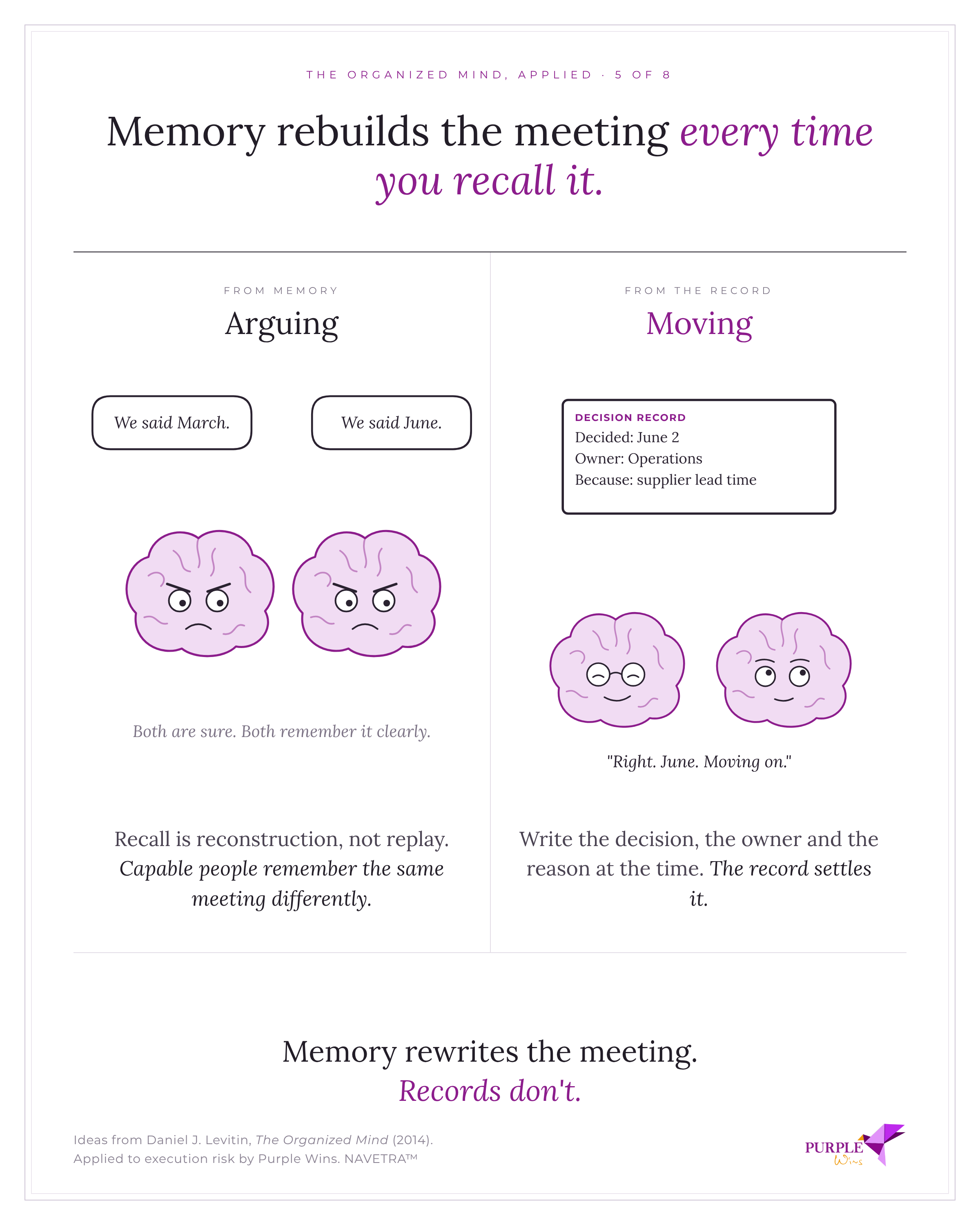
Belief-based debates are polite, well-intentioned and expensive. They sound like this:
"That's not what I'm seeing."
"It depends on the team."
"We need more context."
"Let's revisit this next quarter."
Each of these is reasonable on its own. Together they hold a decision open. The cost shows up as later prioritization, accountability spread across several owners, leaders carrying more than they can move, and windows to act that close before anyone acts.
What a credible baseline is
Engagement surveys, culture indices, maturity models and transformation assessments all have their place. They answer different questions. A baseline for execution risk is built to settle near-term trade-offs, so it is:
Narrowly scoped to the decisions in front of the team
Decision-grade, meaning it is tied to money, not sentiment
Built quickly, so it is current when it is used
Stated as a range, not a score
Its job is simple: make execution risk something the room can discuss on the same terms.
What goes in, and what stays out
A useful baseline concentrates on signals:
where decisions slow
where handoffs stall
where ownership blurs
where capacity falls short of the plan
where knowledge sits with a few people
It deliberately leaves out root-cause perfection, organization-wide coverage on day one, and long survey cycles. Speed matters more than completeness. Credibility matters more than detail.
Why ranges work better than scores
A score invites an argument about the score. A range invites a decision about the risk.
When execution risk is stated as a conservative, realistic and aggressive range, leaders can acknowledge uncertainty without stalling, stress-test a decision against the high end, and choose where to focus first. Boards already read credit, market and operational risk this way. Execution risk can be read the same way. NAVETRA states its Operating Profit at Risk (OPaR) only as a range for this reason.
What changes once a baseline exists
Priorities narrow. Instead of ten initiatives, the team sees the few places where risk concentrates.
Ownership becomes easier to assign. When the exposure is visible and priced, the team can name an owner in the same meeting.
Action starts. The conversation moves from whether a problem exists to what to do in the next 90 days.
A baseline does not slow execution down. It gives the team a place to start.
Keeping the baseline current
Baselines rarely fail because they are wrong. They fail because they go stale. Leaders rotate, workloads shift and conditions change after the first cycle.
The answer is not to rebuild the baseline every quarter. Agree a small set of signals, watch them between cycles, and re-measure where something moves. NAVETRA re-measures the levers that moved, building on earlier reads rather than starting over.
What this means for 2026
With margins tight and change constant, an unresolved belief-based debate carries a real cost. A credible baseline does not make decisions easy. It makes them possible, which is why it belongs at the start of the year's work rather than at the end.
For your own board: put a range on the execution risk inside your next decision.
Start with a Study Group: one live decision, read through 3–10 of your senior leaders. Each leader spends 30–45 minutes, on their own schedule, within a five-day window. You receive a written report and a short live debrief. C$6,400. Individual responses stay confidential. Or bring ten leaders into the room for two days with the True North Leaders’ Accord.
Assess a live decision · or write to admin@purplewins.io
About NAVETRA®. NAVETRA prices execution risk as an Operating Profit at Risk range, readable before a capital or governance commitment hardens, sector-aware, positioned against a reference set of 1,146 companies and 12,405 company-years drawn from public filings and private management reporting. Each range is built from the company's own leaders' evidence and its revenue and operating profit, then read against peers in its sector. What is OPaR?
Ten execution risk levers: Organization Alignment · Executive Alignment · Leadership Bandwidth · Team Effectiveness · Knowledge Retention, Sharing & Transfer · Technology & AI Readiness · Cross-Functional Collaboration · Talent & Hiring Alignment · Sales Readiness / Revenue Conversion · Resilience & Risk Management
Important notice. This article is part of the 2026 CEO Diaries by Mina Johl, CEO of Purple Wins, prepared for informational and thought-leadership purposes only. It does not constitute financial, investment, or legal advice. Figures labelled as illustrations use invented numbers; they are not estimates of loss or of Operating Profit at Risk for any company, and are not the NAVETRA® assessment. NAVETRA®'s method for building an Operating Profit at Risk range is proprietary and is not described here. Image ideas drawn from Daniel J. Levitin, The Organized Mind (2014); Purple Wins is not affiliated with the author or publisher. NAVETRA® is a product of Purple Wins, Ontario, Canada. All trademarks remain the property of their respective owners. © 2026 Purple Wins. NAVETRA® is a registered trademark in Canada.
