

Boeing's $36 Billion Governance Failure: What Leadership Alignment and Organisational Risk Actually Cost
Boeing is the most extensively documented governance failure in modern corporate history. Six consecutive years of losses. $36 billion eroded. Two fatal crashes. A door plug that blew out at 16,000 feet with 177 people on board. And through all of it — the whistleblower complaints filed and ignored, the safety upgrade rejected three times on cost grounds, the board that never once discussed grounding the 737 MAX in the five months between the first crash and the second — the signals were not absent. They were sitting in the organisation, in people who knew, in systems that recorded, in complaints that were filed. What was missing was not data. It was the organisational infrastructure to translate what the data showed into a decision the people with authority could make. That is not a technical failure. It is a Leadership Alignment failure. A Knowledge Transfer failure. A Cross-Functional Alignment failure. These are measurable domains. And they are exactly what NAVETRA™

Ford's Software Recall Surge. Was every cause a Governance Failure?
Ford shattered the US recall record in 2025 — 152 campaigns, 5.6 million vehicles recalled across three software failures in nine months, a $1.7 billion regulatory fine, and a $5 billion annual warranty problem that CEO Jim Farley has publicly named as the company's defining challenge. None of it was invisible before it became a line item. The signals were in the warranty data, the telematics feeds, the dealer service records. What was missing was a governance system to translate those signals into financial exposure — with owners, thresholds, and a decision gate — before they compounded into the largest recall year in American automotive history. This is what that system looks like.

Stellantis, €25.4B, and Unnecessary EBITDA Exposure. Was it Governable?
Stellantis’ FY2025 net loss (€22.3B) wasn’t driven primarily by the underlying operating result (AOI: −€0.842B). It was driven by €25.4B in unusual charges tied to cancellations, impairments, warranty estimate changes, and EV supply-chain resizing. This analysis separates what the market caused from what governance allowed to accumulate—and maps four capabilities (quantify, prioritise, mitigate, predict) to reducing unnecessary EBITDA exposure.
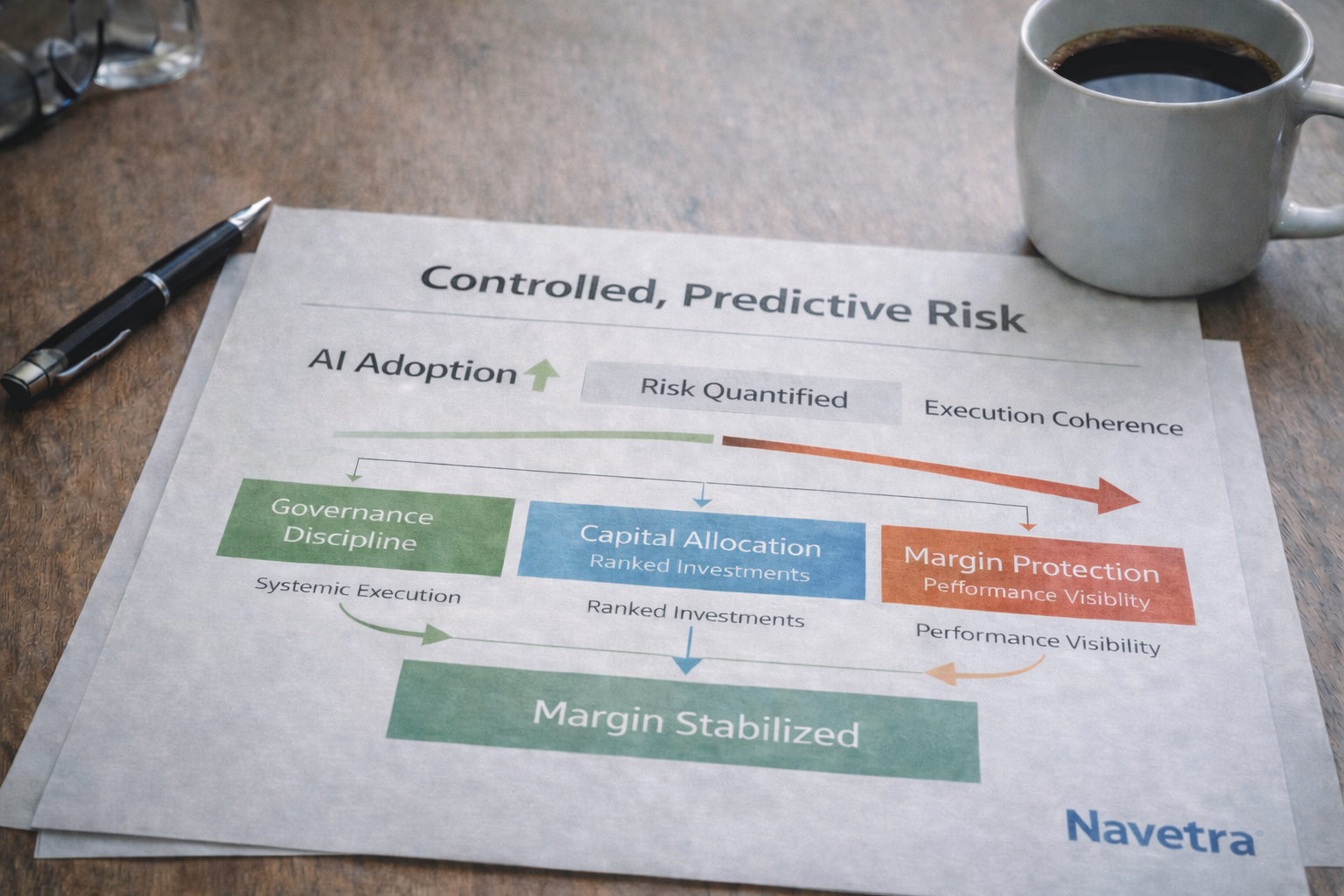
AI Scales Fast. Execution Governance Must Too.
Choosing the right AI is not a bottleneck.
Most enterprises already have access to powerful models, automation tools, and data infrastructure.
The constraint isn’t capability.
It’s coherence.
When process, people, and technology are misaligned, AI accelerates the friction:
• Decision latency increases
• Cross-functional gaps widen
• Capital flows to visible upgrades instead of structural constraints
Speed without governance compounds drag.
Execution discipline — not model sophistication — determines whether AI becomes a margin amplifier or a risk multiplier.

2026 CEO Diaries: Why 90 Days Is the Right Unit of Execution Risk Reduction
Execution risk doesn’t yield to annual plans or quarterly reviews. In 2026, CEOs are reducing execution risk in disciplined 90-day cycles—long enough to matter, short enough to govern.

2026 CEO Diaries: RISK5 — Five OIaR Signals CEOs Can Check This Week
RISK5 is a practical checklist CEOs can use this week to spot five execution risks that quietly erode margin. It’s not a diagnosis—it’s a way to decide where to look first.

2026 CEO Diaries: Always-On Execution — Why Drift Is the Real Enemy
Execution rarely fails outright. It erodes through drift—small changes in ownership, priorities, and handoffs that go unnoticed until results suffer. In 2026, CEOs are treating always-on execution as continuity infrastructure, not automation.

2026 CEO Diaries: The Baseline That Prevents Belief-Based Debates
Most leadership debates stall because execution risk is discussed without a shared baseline. In 2026, CEOs are using narrow, decision-grade baselines to replace belief with focus and move faster.

2026 CEO Diaries: How Boards Will Interrogate Execution Risk in 2026
In 2026, boards are no longer debating whether execution matters. They are interrogating where the risk sits, how large it is, and how leaders intend to govern it. This article outlines the six questions shaping execution-risk conversations in boardrooms today.

2026 CEO Diaries: Stop calling it “soft.” Price execution-risk like insurers do.
Execution risk has long been mislabeled as “soft.” In reality, it behaves like a priced exposure—eroding margin through decision latency, fractured handoffs, ownership drift, and talent friction. In 2026, leading CEOs are reframing this risk as Margin-At-Risk from Talent & Execution (MAR-T), using bounded ranges and governance discipline to focus action where it matters most.

2026 CEO Diaries: The 5 Execution Risks That Quietly Erode Margin
Execution risk rarely announces itself. It accumulates quietly—through delayed decisions, fractured handoffs, drifting ownership, hiring friction, and fragile knowledge. In 2026, with tighter margins and higher complexity, these execution failures are no longer tolerable or defensible. This article outlines the five execution risks most likely to erode margin—and how CEOs can spot them early, before they compound into financial exposure.

2026 CEO Diaries: Execution Risk Is Now Priced as Margin-at-Risk
Execution risk is now priced as margin-at-risk.
Not because leaders suddenly care more about “soft issues,” but because boards care about risk reduction and returns — and execution is where margin quietly leaks:
• decision latency
• cross-functional handoffs
• ownership drift
• hiring friction
• knowledge fragility
The shift in 2026 is simple:
We’re moving from anecdotes to decision-grade exposure—often expressed as a floor / most-likely / upper-bound margin-at-risk band.
That doesn’t replace leadership judgment.
It makes priorities defensible.
What’s the biggest execution risk you see quietly eroding margin right now: decision velocity, handoffs, or hiring friction?

ADKAR + Kirkpatrick: Closing the Gap Between Change Programs and Real Results
Most organizations can show you the inputs of transformation—training hours, completions, participation, feedback scores. But when a CEO or CFO asks the only two questions that matter, the room often goes quiet:
Are people actually behaving differently at work?
And is that behaviour change showing up in business results?
That gap—between “we ran the program” and “we can see the impact”—is where change fatigue grows, credibility erodes, and real value quietly leaks out of the P&L.
Frameworks like ADKAR® and the Kirkpatrick Model are still the right foundation. They help you design the journey and define what “impact” should mean. The hard part is operating confidently in Kirkpatrick Level 3 and 4—where behaviours show up in the messy reality of handoffs, decisions, rhythms, escalation, rework, and cross-functional execution.
That’s the space Navetra™ was built for: making system behaviour visible (Level 3) and connecting it to business consequences (Level 4)—so leaders can reinforce what’s working, unblock what’s stuck, and steer change with clearer eyes.